|
|
 |
 |
 |
|
|
|||||
|

Board Chairman---- Dr. Shih-Hsuan Sung
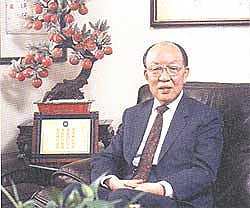
Chaoyang's Founder--Dr. Yang Tien-sheng
School Grounds and Building Space
Faculty, Staff,and Student Enrollment
 President of the University |
Chaoyang University of Technology upholds its unique management style values. Also, in order
to challenge the rapid changing environments and continue to grow, Chaoyang needs to take on the fundamental principles, including double
As, double Bs, and double Cs: |
Chaoyang University of Technology was founded in 1994 through the generosity of Dr. Tien-sheng Yang, president of the Ever Fortune Group, a major R.O.C. conglomerate, in memory of his parents, and in return for the support he received throughout the years from the people and communities of central Taiwan. In 1988 he chose a site in Taichung County's Wufeng Township, and after six years of preparation, on April 14, 1994, it received permission from the Ministry of Education to begin accepting students as "Chaoyang Institute of Technology." The school takes its name from a passage in the Chinese classical work "The Book of Changes," a phrase which captures the school's vigorous growth and its students' active commitment to learning.
In its first year, Chaoyang had eight departments and over 900 students. Due to its commitment to quality in education and outstanding achievements, on August 1, 1997, Chaoyang was designated by the Ministry of Education as a University of Technology, the highest level in the R.O.C.'s polytechnic educational system. This designation, coming only three years after Chaoyang opened its doors, set a record in the R.O.C. 's educational history, which remains unbroken. In addition to its new designation, Chaoyang has continued to expand, and today boasts four colleges, nine graduate schools, and nineteen departments, as well as its Evening Division, General Education Center, Center for Teacher Education, Continuing Education Center, Office of Research and Development, The Business Incubation Center, and affiliated kindergarten. Faculty and staff now number 556 and student enrollment is 13,402.
Diligence, Betterment, Practice
Diligence: earnest study in pursuit of the truth
Betterment: self-cultivation to add strength of character
Practice: self-discipline in service to the public welfare
Chaoyang's insignia is blue and white. These colors symbolize the serenity and detachment essential to the pursuit of knowledge and learning.
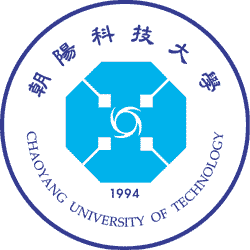
The insignia itself uses four square T-shapes, standing for technology, and four beams of light directed inward, each ending at a bolt-like block at the center. The outer border is octagonal, representing the eight trigrams of the I-ching. The beams of light are concentrated around a central sun, which symbolizes youth in pursuit of knowledge. The four T shapes represents the school's commitment to excellence in instruction, excellence in resources, vocational programs, and improvement of commerce and industry. The four bolt shapes represent the faculty's dedication to instruction, research, and mentorship of students.
Board Chairman-- Dr. Shih-Hsuan Sung
Chairman: Dr. Sung Shih-hsuan
 Experiences:
1. President, Headquarter of China Youth Corps
2. General Director, Taiwan Provincial Committee of Kuomintang Party
3. Director, Organization and Development Committee, Central Committee of KMT
4. President, Broadcasting Corporation of China
5. National Policy Advisor (to Dr. Teng-Huei Lee, the Formal President of the ROC)
Chaoyang's Founder--Dr. Yang Tien-sheng
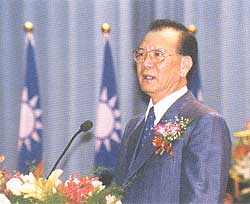
Position:
1. Chairman, Ever Fortune Industrial Co., Ltd.
2. Chairman, Chang Sheng Power Company. (Hai-hu Power Plant in Taoyuan)
3. Chairman, Chang Sheng International Development Co., Ltd. (Rapid Transit System at CKS Airport)
4. Chairman, Yue-Mei International Development Co., Ltd. (Yamay World)
5. Chairman, Por-ding Culture & Education Foundation
6. General Director, Chinese National Federation of Industries
Experiences:
1. Representative, the 1st-Term National Assembly, and Chairman, the 1st-Term National Assembly Committee
2. President, Construction Engineering Association of the ROC
3. President, Taiwan Provincial Construction Engineering Association
4. President, Taiwan Provincial Industrial Association
5. President, Taiwan Provincial Leather Association
6. President, Taichung County Industrial Association
7. President, Table Tennis Association of the ROC
8. Founder, Pan Asia Bank
In its policies and administration, the University upholds the following values and requires the following programs:
|
|
It values professional knowledge, a global perspective, communication and cooperation, and the ability to make timely use of all relevant information; |
|
|
It emphasizes proper conduct, professional ethics, good judgment, and a responsible attitude; |
|
|
It requires all students to complete a labor education program in order to develop a balanced physical and mental work ethic; |
|
|
It instills self-discipline and self-respect in its students, and cultivates their ability to live and study as independent individuals; |
|
|
It emphasizes academic exchange in order to combine local and international strengths and raise academic standards; |
|
|
It will establish technical research and development centers, and provide service to industry through technical cooperation. |
Chaoyang was founded based on the following goals:
|
|
That it should respect academic freedom, uphold the dignity of education , and foster an ethical, democratic learning environment; |
|
|
That it should develop skilled professionals with high standards of ethics and character, to meet the needs of society; |
|
|
That it should put into practice the school motto of "Diligence, Betterment, and Practice"; |
|
|
That it should emphasize practical teaching and research, in order to fulfill the goals of polytechnic education; |
|
|
That it should promote exchange and cooperation between industry, government, and academia, and raise the standards and quality of industry; |
|
|
That it should base itself in Taiwan, Surpass Asia, and challenge the world, always seeking excellence. |
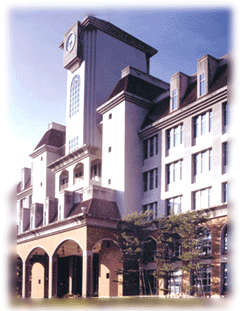
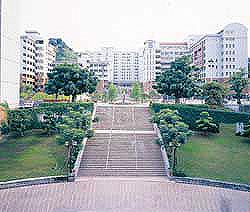
Current school facilities include the Administration, Information, Science and Engineering, Teaching, Humanities and Technology, Design and Management Building, Poding Memorial Library, the Freshman dormitories, Parking Building, the University's affiliated Kindergarten and the athletics Building, a total of 12 buildings, with total floor space of 153,635 square meters, a 400 meter athletic field, and basketball, tennis, and volleyball courts for physical education instruction and faculty and student leisure use.
Faculty, Staff,and Student Enrollment
In the 2004 school year, Chaoyang's full-time faculty numbered 323. Of these, 65 percent held the rank of assistant professor or higher, or a doctoral degree. Staff number 170, most with an associate or bachelor's degree. The total number of enrolled students is now 11,514; among these, graduate students number 720 and undergraduates number 10,794.
|
|
Campus |
Area: 27 hectares with
more then 12 buildings
Student Housing: 2 Halls of Residence providing residences for about 1,641 students |
students |
Master's degree programs: 1,290 Undergraduate programs:12,112 |
|
Staff |
204 | |
Faculty |
Full Professors: 23 Associate Professors: 113 Assistant Professors: 100 Lecturers: 116 |
|
Alumni |
15,276 | |
International
|
29 university-wide formal linkages or exchange agreements with institutions in 8 countries |
|
Chaoyang University of Technology |
|||||
| Address : |
|
||||
| TEL: | 886-4-23323000 | FAX: | 886-4-23329898 | http://www.cyut.edu.tw | |
The
College of Science and Engineering
The
College of Humanities and Social Sciences
The College of Management was established in August 1997, and now has six departments: Finance, Business Administration, Information Management, Leisure, Recreation and Tourism Management, Insurance and Accounting. Master programs are offered by all the six departments. The College is the largest in the University. Its faculty include 4 professors, 43 associate professors, 30 assistant professors, and 47 lecturers. Faculty thus numbers 124; of these, 75 hold doctoral degrees, while 49 hold master's degrees. Student enrollment (including the Evening School) totals over 6,489, while the master's level students number 512.
The College's strong faculty allows its various departments to offer a diverse curriculum. At the same time, the College also offers several interdisciplinary programs to expand learning opportunity and to facilitate developing sub-specialties for more ambitious students. In addition, in order to further integrate resources, raise research levels, and promote academic exchange, since 1999 the College has begun to organize an annual nation-wide academic conference addressed to management-related issues. The College is confident that through the collective efforts of its faculty and students, it will become a distinctive, first-rate management talent source for the country. The following is a brief description of the various departments under the College.(more.......)
The College of Science and Engineering
The College of Science and Engineering was established in August 1997, and currently has five departments, and a graduate institute: Construction Engineering, Industrial Engineering and Management, Applied Chemistry, Environmental Engineering and Management, Information and Communication Engineering, and Graduate Institute of Networking and Communication Engineering. The goal of the College is to produce professionals in science and technological management. The College faculty include 6 professors, 36 associate professors, 33 assistant professors, and 3 lecturers, a total of 78, with doctoral degree holders accounting for 74 of these and master's degree holders accounting for 4; total student enrollment in the College is now 2,978.
The College also has master's programs in Construction Engineering, Industrial Engineering and Management, Applied Chemistry, Environmental Engineering and Management, and Information and communication Engineering, supplying opportunities for advanced studies and research.
The College encourages its departments to hold professional seminars and conferences both on and off campus, to regularly engage in a variety of international academic exchanges, and to implement cooperative agreements and internships with industry, in order to improve and strengthen teaching, research, and service. The College also offers an inter-disciplinary "Construction Management" program, and encourages its departments to develop secondary curricula and cross-disciplinary programs, in order to ensure that after graduate students enter the job market with skills that will allow them to build a strong future with industry. Following is a brief description of the departments under the College.(more......)
Skillful intervention by a designer requires the integrated knowledge of social, cultural, natural, economic and technological factors, and design ability consists of the capacity to identify, analyze and solve problems in a creative way.
In the College of Design the undergraduate degrees are aimed at providing a broad base to give students the opportunity to specialize in specific aspects of design. The College is concerned with equipping its graduates to meet social challenges so that they may help to determine the nature of future developments. To do this, it requires graduates with compassion for people, intelligence, creative ability and dedication. From 2002, the College offers a Ph.D. program in Architecture and Graduate Institute of Design.
The College faculty include 2 professors, 9 associate professors, 14 assistant professors, and 26 lecturers, a total of 51, with doctoral degree holders accounting for 18 of these and master's degree holders accounting for 33; total student enrollment in the College is now 1,460.
Following is a brief description of the departments in the College.(more......)
The College of Humanities and Social Sciences
"Technology improves the conditions of our lives, the humanities improve the quality of our lives". Based on this belief, Chaoyang University of Technology established the College of Humanities and Social Sciences in August 1997. The University expects the College will provide a strong base in humanities, ethics and skills throughout the University. The College is composed of four departments (Communication Arts, Applied Foreign Languages, Early Childhood Development and Education, and Social Work) and one center (Center for Teacher Education). Currently, Department of Early Childhood Development and Education offers the Master Program (including the regular program and the in-service programs). Besides, one more master program will be set up by the Department of Applied Foreign Languages in 2003, and two more by the Department of Communication Arts and the Department of Social Work in 2004.
The College's faculty now consists of 6 full professors, 7 associate professors, 18 assistant professors, and 37 lecturers. Of these, 29 hold doctoral degrees and 39 hold master's degrees. Totally, the number of students in the college is 2,594.
Following is a brief description of the departments under the College.(more.....)
The College of Management
TEL: 886-4-2332-3000 ext. 7541
FAX: 886-4-2374-2369
E-mail: mcollege@mail.cyut.edu.tw
The College of Science and Engineering
TEL: 886-4-2332-3000 ext. 7572
FAX: 886-4-2374-2371
E-mail: soe@mail.cyut.edu.tw
The College of Design
TEL: 886-4-2332-3000 ext. 7151
FAX: 886-4-2374-2339
E-mail: dcollege@mail.cyut.edu.tw
The College of Humanities and Social Sciences
TEL: 886-4-2332-3000 ext. 7512
FAX: 886-4-2374-2367
E-mail: humanity@mail.cyut.edu.tw
The Evening Division
TEL:886-4-2332-3000 ext. 4621
FAX: 886-4-2374-2347
E-mail: contedu@mail.cyut.edu.tw
The Continuing Education Center
TEL:886-4-2211-1088
FAX: 886-4-2221-1050
E-mail: ec@mail.cyut.edu.tw